Videos

Lise
Switsers
Thomas More Hogeschool

Tackling loneliness: how small things make a big difference

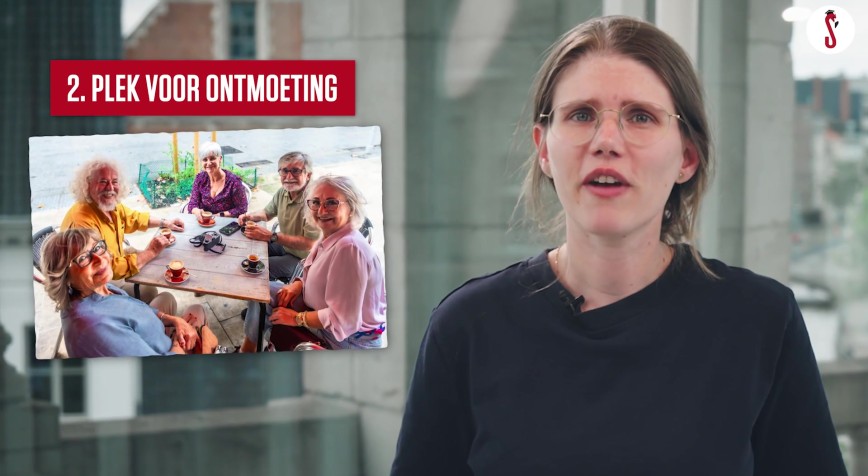
A baker, a butcher, and a cup of coffee with the neighbors: that was all it took to pull Marlène out of her loneliness. Researcher Lise Switsers discovered how a weekly market is bringing an entire village back together. Small changes with a big impact.
Liesbeth
Naessens
Odisee

Ready for life after prison?

Imagine this: a man called Tom is due to be released from prison tomorrow, but without an income, internet access or a place to live, it’s not easy to start afresh. Liesbeth Naessens (Odisee) investigates how halfway houses help people leaving prison to build a new life, step by step.
Jan
Lim
KU Leuven

How citizens can shape urban planning

"Leave it to the experts. You don't understand the technical stuff." A thought city planners sometimes have. But urban designer and researcher Jan Lim (KU Leuven) argues for something different: meaningful citizen involvement. "City planning isn't just technical. It's also political... These choices shape the kind of city we live in. So citizens need to talk about them."
Ella
Egberts
VUB

Transforming landscapes: the water-saving terraces of ancient cyprus

How did people in dry regions like Cyprus survive long periods without rain? Thousands of years ago, they built stone terraces to slow down water, allowing it to soak into the soil and nourish crops. At VUB, archaeologist Ella Egberts is combining archaeological fieldwork with scientific analysis to uncover how these systems worked — and what they can teach us about drought resilience today.
🎥 Watch the video to discover how ancient solutions can inspire a more sustainable future.
Vincent
Ogembo
VUB

Lake Victoria: How to predict future floods?

Flooding around Lake Victoria has become increasingly deadly — with hundreds of lives lost and millions affected in recent years. But better forecasting could make all the difference.
Vincent Ogembo (VUB) is developing a Integrated Water Balance Model, that brings together satellite data and lake outflow measurements to predict future flood scenarios up to 2100. This research will help governments anticipate rising water levels and issue early flood warnings before disaster strikes.
Luigi
Oddo
VUB

Tackling climate's impact on agriculture by studying history

Can studying history help farmers survive climate change?
Luigi Oddo, (VUB) studies how farming communities across Europe adapted to extreme weather centuries ago. By examining historical weather patterns, farming records, and even tree rings, he uncovers strategies that could help today’s farmers face the challenges of climate change.
His research shows that the past holds not just stories, but solutions.


Nishat
Hyder-Rahman
VUB

What makes your mother, your mother? Legal parenthood and assisted reproduction.

What makes someone a parent? In families formed through assisted reproduction, that answer isn’t always clear — and the law doesn’t always keep up.
Nishat Hyder-Rahman, researcher at VUB, is working on a legal framework that improves birth registration so that it reflects the real-life complexity of modern parenthood. Her research compares international approaches and listens to families, donors, and surrogates to develop better legal recognition.
Silke
Marynissen
FWO
VUB

Is there music in prison?

99% of people in prison are released at some point. So it is crucial to prepare them for this release. Music can help with this, explains education scientist Silke Marynissen (VUB - FWO) in this video.
Janine Patricia
Santos
KU Leuven

Local tech solutions to global problems: learning from Lomé's young innovators

Ousia and Afate, innovators from Lomé, Togo, created a 3D printer out of old computer parts, making their small city famous around the world. Their story is about more than just innovation; it also highlights the challenges that come with limited access to technology. In this video, Janine Patricia Santos (KU Leuven) describes how she spent 15 months in Lomé to learn how they overcome these obstacles. Their approach shows how local creativity can solve global issues like e-waste. 🌍
Lisa-Marie
Hemerijckx
KU Leuven

Urbanisation and food systems in the Global South

As cities grow, getting enough food to everyone becomes a bigger challenge, especially in fast-developing places.In places like Kampala, Uganda, reaching markets is a challenge due to inadequate infrastructure and traffic. Lisa-Marie Hemerijckx (KU Leuven) studies how people in fast-growing cities access food, to help planners improve food availability and make urban growth more sustainable.
Bettina
De Ruyck

Exploring shareholder approval of environmental and social goals

Managers of large companies get bonuses for achieving financial goals, such as increasing profits. But what do shareholders think about giving these managers a bonus for environmental and social goals, such as reducing emissions or improving employee well-being? This is what Bettina De Ruyck looked into. "Bonuses for non-financial objectives are twice as common in managers' pay compared to ten years ago."
Saimum
Parveza
VUB

The religious lives of Bangladeshis in Europe

Why is it that Muslim migrants seem to become more religious after arriving in Europe, in a secular society? That's what Saimum Parvez (VUB) is investigating. He's looking into the case of Bangladeshi migrants, by raising questions such as: how do they participate in religious rituals? Do they see themselves as religious? And what impact does migration have on their religion?